| A
Brief History of Sledding
It
is not known exactly when snow sleds made their debut. Early on,
rudimentary snow sleds were made from two logs fashioned together.
These were mainly used for transportation. Development of the 'sled"
lead to the discovery of runners, a much more effective tool. Runners
are smooth planks fastened to the bottom of the sled. These runners
allowed the rider to move faster and maintain speed longer. Pilgrims
used this concept to move supplies in the winter as well as for
recreation.
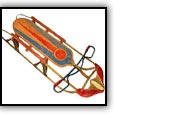
By 1870, the most popular snow sled in America was the 'clipper."
It had runners made of steel rods, and was built low to the ground.
The 'girl sled" later developed. It was merely a box with higher
sides than the clipper. The 'girl sled" had wide, flat runners,
forcing it to go slower than the clipper. Later, the 'double-runner"
or bobsled developed. Two clippers were placed end to end and linked
by a board. Up to ten people could ride the bobsled at one time.
The riders could steer using a rope, crossbar, or a wheel.
Bobsleds used in racing, especially in the Olympics, are much more
complicated snow sleds. The Luge and the Slalom are also based on
the snow sled concept. Even skis are just two runners without the
actual sled attached.
Snow sleds are still used in transportation in more artic areas
of the world. In Alaska snow sleds are used in conjunction with
snow dogs (Alaskan Malamutes, Siberian Huskies, etc.) to pull large
loads. During the coldest months, snow sleds are the only means
of transportation sans snowmobiles, especially over great distances.
The Iditarod, the most famous of the snow sled/snow dog race, is
held in Alaska every year. It's origin lies in the gold rushes in
the late 19th to early 20th centuries.
Sledding, although used more today for recreation than for more
practical uses, has much history. Snow sleds are still being developed
today.
|